Building Safety Act · 9 min read
The Building Safety Act 2022 and Fire Doors: What Developers and Contractors Must Know
Read
The Fire Safety (England) Regulations 2022 set specific fire-door duties for relevant residential buildings. This guide explains the inspection, access-record and resident-information requirements.
The Fire Safety (England) Regulations 2022 came into force on 23 January 2023. Regulation 10 creates specific fire-door duties for responsible persons in relevant residential buildings, while separate resident-information duties apply in residential buildings with common parts. The precise duties depend on the building and its height.
Key Legal Obligation
For relevant residential buildings above 11 metres, Regulation 10 requires communal fire doors to be checked at least every 3 months and flat entrance doors to be checked at least every 12 months using best endeavours. Records should show the steps taken where access to a flat entrance door was not obtained.
The 2022 Regulations sit alongside the Regulatory Reform (Fire Safety) Order 2005, as amended by the Fire Safety Act 2021. They apply to the responsible person and introduce separate fire-door and resident-information duties for relevant residential buildings.
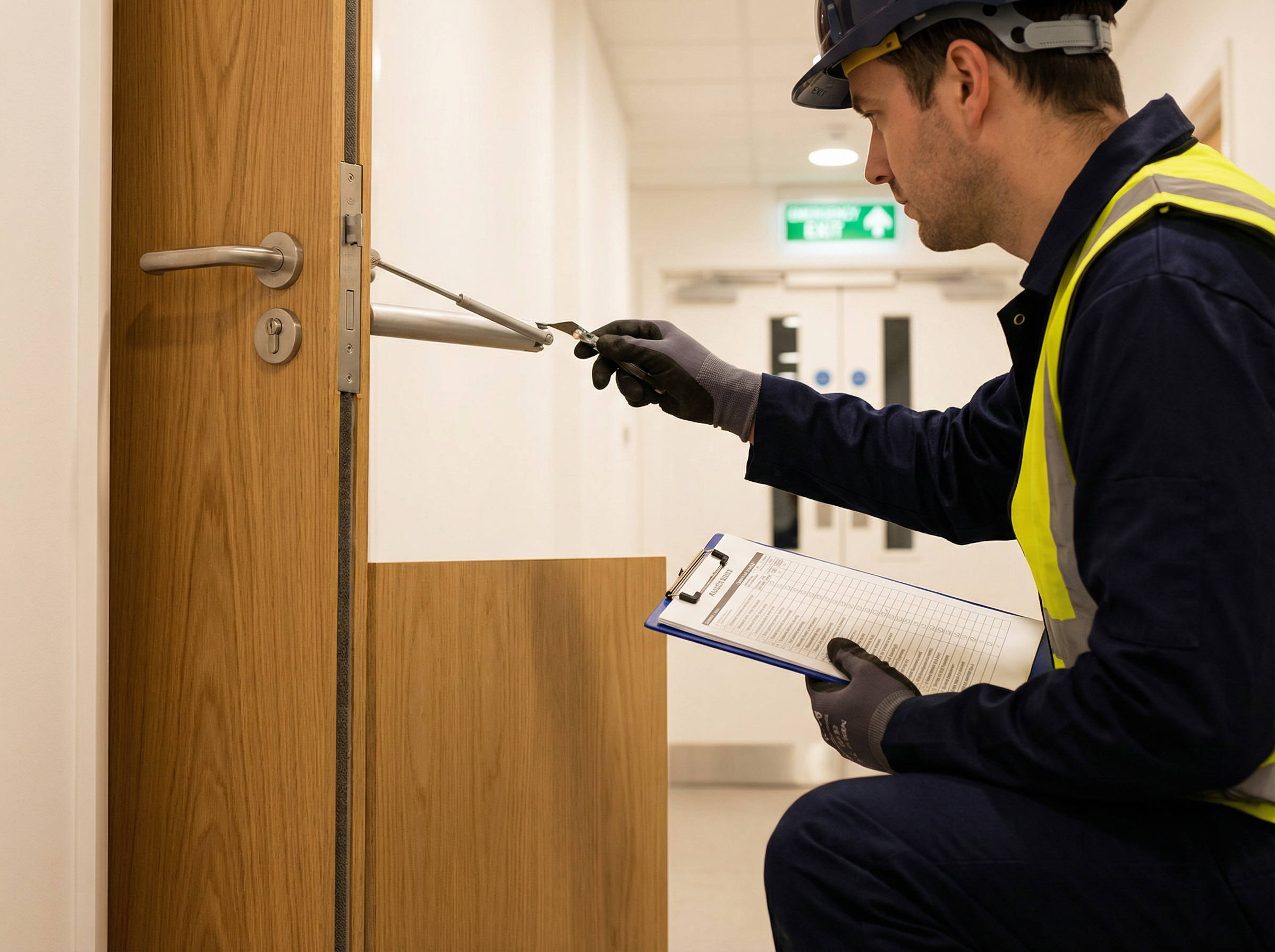
For relevant residential buildings above 11 metres, responsible persons must check communal fire doors at least every 3 months. Government guidance describes checks of the door’s condition and the efficiency of self-closing devices. The appropriate inspection scope should take account of the fire strategy and the type of door being considered.
Responsible persons must use best endeavours to check flat entrance doors at least every 12 months. This requires a planned approach to gaining access. Where access is not obtained, the responsible person should retain a record of the steps taken.
Responsible persons must provide residents with fire-door information in the circumstances set out in the Regulations and Government guidance. This includes information on the importance of keeping fire doors shut when not in use and not tampering with self-closing devices.
The Regulations do not prescribe one universal technical checklist. Government guidance explains the purpose of the routine checks; the detailed scope should be selected for the door, premises and fire strategy. A project-specific inspection may consider the following:
The term 'responsible person' is defined in Article 3 of the Regulatory Reform (Fire Safety) Order 2005. In a residential building, this is typically the building owner, the freeholder, the managing agent acting on behalf of the freeholder, or the residents' management company. In commercial premises, it is the employer or the person in control of the premises.
Critically, the responsible person cannot transfer their legal obligations to a third party. They can appoint a competent contractor to carry out checks on their behalf, but the duty to ensure those checks are carried out — and documented — remains with the responsible person.
Under the Regulatory Reform (Fire Safety) Order 2005, the enforcing authority is ordinarily the fire and rescue authority. Enforcement action and penalties depend on the facts, the relevant statutory provision and the enforcing authority’s powers. Responsible persons should obtain appropriate legal and fire-safety advice where enforcement action is possible.
Enforcement in Practice
Keep records that show the inspections, access attempts and remedial decisions made for the building. Those records support the responsible person’s wider fire-safety management and should be available for review where appropriate.
Eagle Fire offers fire door inspection and survey work across North West England.
Discuss an inspection programme for a relevant building in Greater Manchester, Cheshire, Merseyside or Lancashire.
Book a Compliance InspectionThis article is general information, not legal advice. Review the original guidance and consider the circumstances of the premises.